
Sea Salt and Aquatic Fragrances: The Documents Behind the Notes
Sea salt and aquatic fragrances look like simple, fresh products, but they are built on synthetic materials chosen precisely because they are potent at low doses, and potency is exactly what the compliance rules police. The documents behind a marine accord matter more than the marketing copy: the substance list, the usage screen, the allergen check and the market-specific labelling have to line up before the bottle is legal to sell. For a men's line sold on freshness, getting these four documents right is the difference between a clean launch and a stop-sale.
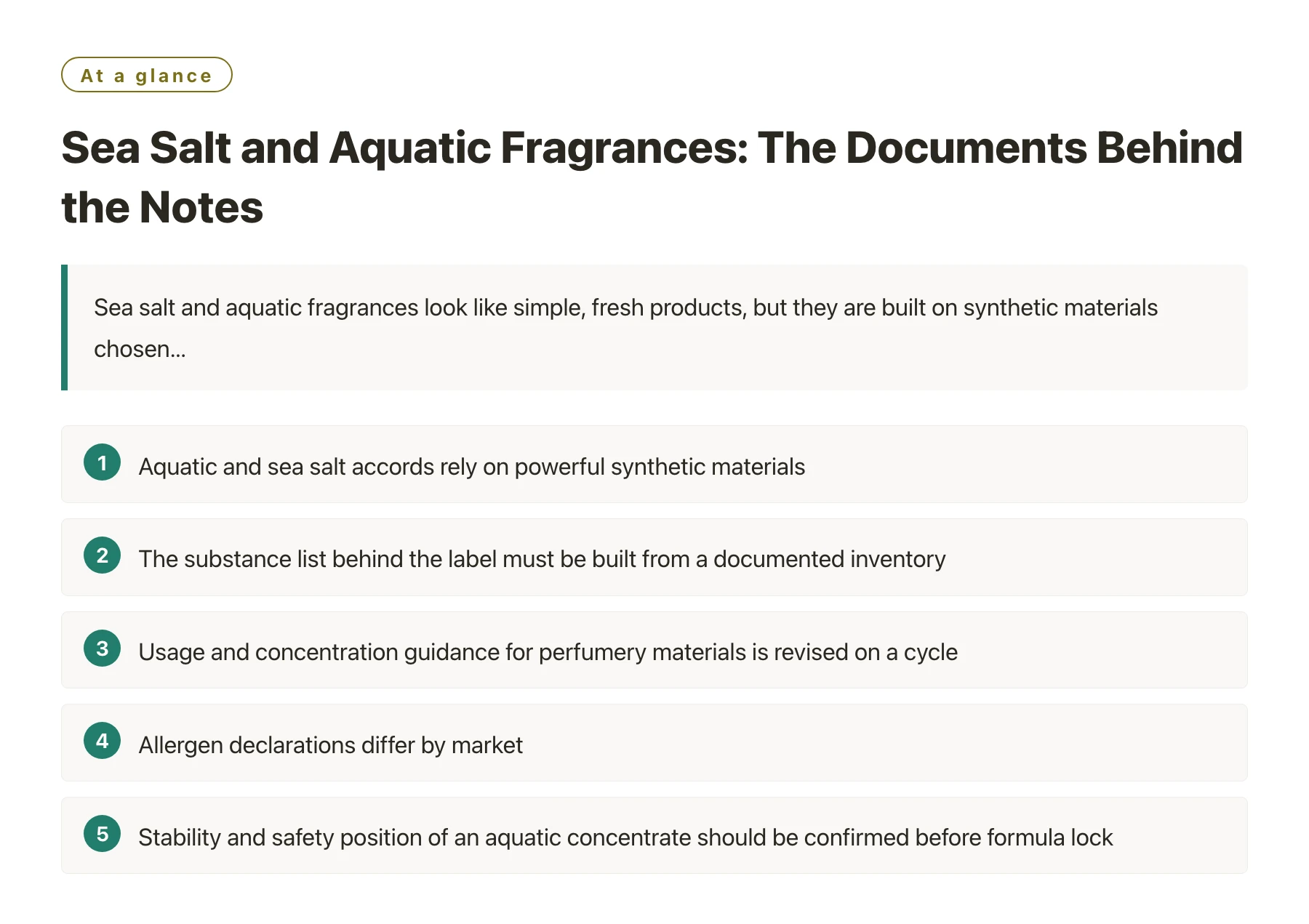
Key takeaways
- Aquatic and sea salt accords rely on powerful synthetic materials, and the same potency that makes a scent fresh is what the usage rules restrict.
- The substance list behind the label must be built from a documented inventory, and it is the anchor of every other compliance document.
- Usage and concentration guidance for perfumery materials is revised on a cycle, so the formula has to be screened against the current version, not the one from launch year.
- Allergen declarations differ by market, and a mistake in the allergen list is one of the most expensive label errors a brand can make.
- Stability and safety position of an aquatic concentrate should be confirmed before formula lock, because a refusal after production starts is a full stop.
Most buyers meet aquatic notes through the marketing: ocean air, salt breeze, clean cotton. The manufacturing side is less romantic and more regulatory: a marine accord is a small set of very potent molecules, and potency is the property that safety rules are written around.
For a men's line, where freshness and projection are the selling points, the temptation is to push the accord harder, which is exactly when the documentation has to be right.
This article walks the document set a sea salt or aquatic fragrance needs, in the order a compliance reviewer would check it.
Why aquatic notes attract attention from regulators
A fresh marine effect is usually achieved with a small number of high-impact synthetic materials that read as water, ozone or salt at remarkably low concentrations. Because they are used at low doses, the historical experience base is thinner than for classic floral or woody materials, and the safety review tail is correspondingly longer.
That is why the substance list matters. The finished product's ingredient list is built from a documented inventory of substances, and a marine accord's molecules have to be named, declared and screened like any other ingredient [1].
It is also the reason the usage screen cannot be skipped. Perfumery materials are accompanied by usage and concentration guidance, maintained through a standards system that continues to be revised, and each revision can tighten the limit on a material a formula already uses [2].
The potency paradox in one line
The property that makes a marine accord smell like the sea at one part in a thousand is the same property that makes its use limit the most restrictive line in the safety review. Freshness is not free of paperwork.
The document set, and when each one matters
| Document | What it is for | When you hit it |
|---|---|---|
| Substance list | Names every ingredient behind the label | At the brief stage, before artwork |
| Usage and concentration screen | Shows the formula fits current guidance for every material | At formula review, before lock |
| Allergen declaration | Feeds mandatory labelling in many markets | Before artwork and label approval |
| Safety assessment and stability | Confirms the product is safe and stable at the chosen concentration | Before the bulk order |
| Market-specific filing | Meets the notification or registration rules of the destination | Before first shipment, market by market |
The order matters: the substance list comes first because every later document depends on its accuracy.
The three checks a men's aquatic line should never skip
The first check is the allergen list. Allergen labelling requirements for cosmetic products exist precisely because fragrance materials cause sensitisation, and the mandatory declaration list is part of the labelling rules applied by the relevant authorities in the destination market [3]. For an aquatic fresh scent, several of the staple molecules sit on or near those lists, so the label is not a formality: it is the product of the substance data.
The second check is the usage screen against the current guidance revision. A formula that was fine at launch can be affected by a later revision, which is why the factory, not the brand, should be able to say which version the product was screened against [2].
The third check is stability at the chosen concentration. Marine accords interact with the alcohol base and other materials over time, and a scent that starts bright can dull or shift after months in the bottle. Confirming that behaviour before the bulk order is cheaper than discovering it on a retailer's shelf.
What to ask the factory, in writing
Ask for the substance list, the guidance version used for the screen, the allergen declaration for your markets, and the stability summary. A supplier that produces these four in one file has the process under control; one that improvises is running the programme without it.
When the factory develops the scent to your brief, the same four documents are part of the delivered programme, which is the practical content of bespoke fragrance development and production: the scent is built together with the paperwork that makes it sellable.
The compliance summary for aquatic notes in one sentence: an aquatic accord that passes the substance list, the current usage screen, the allergen declaration and the stability check is rare enough to be worth protecting. Get those four right and the freshness sells itself.
Where the category knowledge shows up
The difference between a factory that makes aquatic fragrances and one that merely fills them shows in the first meeting: the right supplier volunteers the material discussion and the screen, instead of waiting to be asked. The broader conversation about the notes, including how the accord is built, is exactly the kind of category writing worth reading before you choose a partner salt and marine accords in perfumery.
A men's line built this way still has to win on scent and story like any other, but the foundation is boringly reliable, which is the point.
Sources
- EU CosIng — Cosmetic Ingredient Database (European Commission) —— The European Commission's CosIng database of cosmetic ingredients, listing ingredient functions, restrictions and labelling requirements under EU cosmetics law.
- IFRA Standards Library (International Fragrance Association) —— The IFRA Standards Library lists the restrictions the fragrance industry applies to individual fragrance ingredients, based on safety assessments; it is the reference point for compliant fragrance formulation.
- EU Scientific Committee on Consumer Safety (SCCS) —— The EU scientific committee that issues opinions on the safety of cosmetic ingredients, including fragrance allergens and their labelling thresholds.
Frequently asked questions
Why do aquatic fragrances need more compliance attention than other scents?
Because their key materials are potent at very low doses, which makes their use limits restrictive and their documentation tail longer. Potency is the feature that sells the scent and the one the rules police.
What is the first document to ask for in an aquatic fragrance project?
The substance list. Every other document, from the usage screen to the allergen declaration to the label, depends on the accuracy of that list.
Can a sea salt fragrance change after production?
Marine accords interact with the alcohol base and other materials over time. Stability work before formula lock is the standard way to confirm the scent holds its brightness in the bottle.
Who should check the allergen declaration: the brand or the factory?
The factory compiles it from the substance data, but the brand is responsible for the label in its market. Both should review it against the destination market's requirements before artwork is finalised.
How often do perfumery usage limits change?
The guidance is maintained through a standards system that revises on a cycle. Products should be screened against the current version, and the buyer should ask which version their formula is built against.